





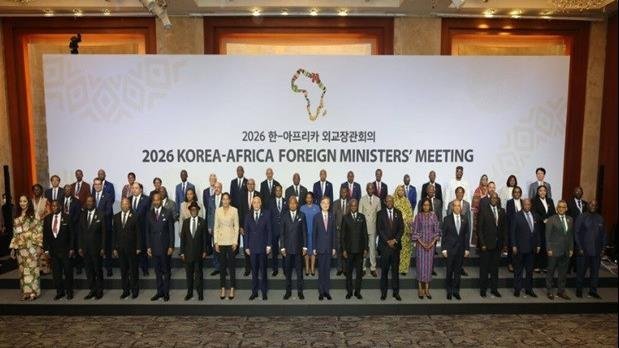
Africa – The Republic of Korea has announced a $24 billion financing package for Africa, marking one of its most ambitious economic engagements with the continent to date. The announcement was made during the Korea–Africa Summit in Seoul and is designed to strengthen trade ties, secure critical resources, and expand South Korea’s global industrial influence.
The initiative comes at a time whenthe continent is increasingly becoming a central battleground for global economic influence, with major powers competing for access to its resources, markets, and strategic partnerships.
Structure of the $24 Billion Deal and What It Covers
The $24 billion package is divided into two main components that reflect South Korea’s blended approach to development and investment.
Around $10 billion is allocated to Official Development Assistance (ODA), focusing on infrastructure development, capacity building, education, digital transformation, and public sector strengthening across African countries.
The remaining $14 billion is dedicated to export financing, which will support South Korean companies investing and operating across the continent. This includes key sectors such as manufacturing, energy, transport systems, telecommunications, and industrial development.
The structure signals a shift away from traditional aid models toward a more integrated approach that combines development support with commercial investment and trade expansion.
Africa’s Strategic Role in Korea’s Global Economic Strategy
A central driver of the partnership is Africa’s abundance of critical minerals such as lithium, cobalt, manganese, and rare earth elements, which are essential for electric vehicles, battery production, and semiconductor manufacturing.
South Korea, a global leader in technology and advanced manufacturing, is seeking to secure stable supply chains as global competition for strategic resources intensifies. The countries, in turn, are leveraging this demand to attract infrastructure funding and industrial partnerships.
The summit also resulted in numerous agreements covering energy, mining, infrastructure, and digital innovation, reflecting a broader effort to deepen economic integration.
This development positions South Korea alongside China, the United States, and the European Union in the race to shape Africa’s economic future—though with a stronger focus on technology-driven industrial cooperation rather than traditional aid diplomacy.