


Senegal is facing one of its most significant political crises in recent history after President Bassirou Diomaye Faye dismissed Prime Minister Ousmane Sonko and dissolved the government, exposing deep fractures within the ruling administration that swept into power just over a year ago.
The dramatic decision has stunned many Senegalese citizens and political observers across Africa, especially considering the close alliance that once existed between the two leaders. Their partnership had symbolized a new era of reform, youth-driven politics, and resistance against the traditional political establishment.
President Faye announced the dissolution of the government amid growing tensions over the direction of the country, governance style, and economic management. While official statements framed the move as a constitutional decision aimed at restoring order and efficiency within government, the dismissal of Sonko has widely been interpreted as the culmination of months of internal power struggles.
From Political Allies to Rivals
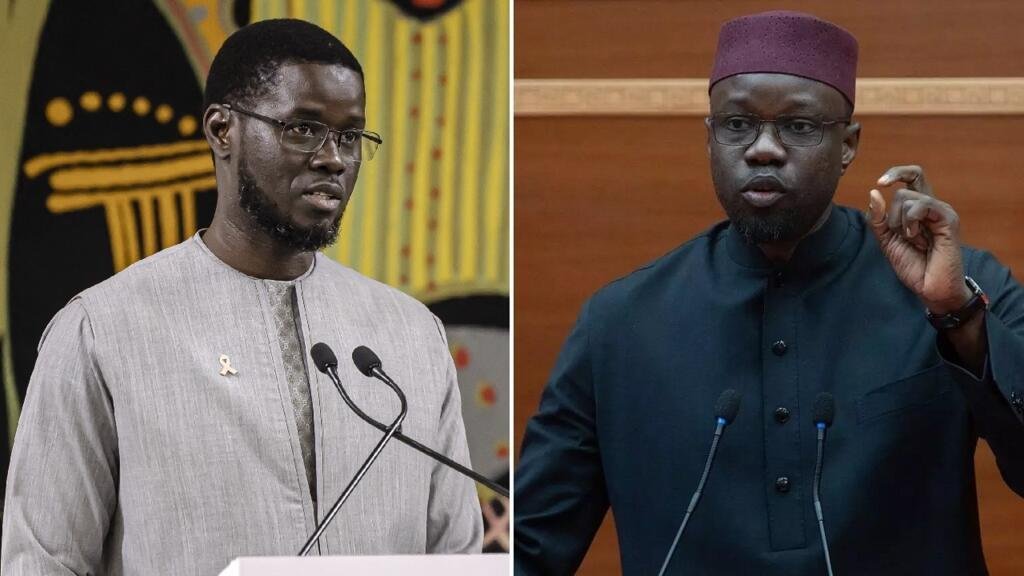
The political alliance between Faye and Sonko played a decisive role in reshaping Senegalese politics during the 2024 presidential elections. Sonko, one of the country’s most influential opposition figures, had been barred from contesting the presidency due to legal troubles that his supporters described as politically motivated. He later endorsed Faye, a close ally within the PASTEF political movement, who eventually secured a historic electoral victory.
Following the election, Faye appointed Sonko as prime minister, creating a leadership arrangement that many analysts described as unusual. While Faye held constitutional authority as president, Sonko remained the movement’s most charismatic and influential figure, particularly among young people and grassroots supporters.
However, signs of tension began emerging shortly after the government took office. Differences reportedly surfaced over economic policy, governance priorities, and the handling of Senegal’s growing financial pressures. The government inherited serious economic challenges, including concerns over hidden public debt and rising pressure from international lenders.
Sonko adopted a more confrontational nationalist approach, calling for the review of foreign contracts in sectors such as oil, gas, and mining. He also pushed for stronger economic sovereignty and greater local control over Senegal’s natural resources. His supporters viewed these positions as necessary steps toward economic independence and fairness.
Critics, however, argued that some of the government’s aggressive rhetoric toward foreign investors created uncertainty in the business environment and risked weakening investor confidence at a time when Senegal needed financial stability.
Reports of disagreements between the president and prime minister became increasingly frequent in recent months. Sonko occasionally made public comments that appeared to contradict or challenge the direction of the presidency, while President Faye warned against divisions within the ruling movement.
What the Crisis Means for Senegal
Political observers say the crisis eventually evolved into a broader struggle over authority and influence within the state.
For many supporters of Sonko, his dismissal may be viewed as an attempt to weaken the ideological foundation of the reform movement that brought the administration to power. Sonko remains extremely popular among many young Senegalese voters who see him as the face of political change and anti-establishment resistance.
On the other hand, supporters of President Faye argue that as the president, he was exercising his constitutional powers to restore discipline and stability within government. Some analysts believe Faye had increasingly become overshadowed by Sonko’s dominant political presence and may have sought to reassert presidential authority.
The dissolution of the government now raises major questions about the future of Senegal’s ruling coalition and the stability of the country’s political system. Although Senegal remains one of West Africa’s strongest democracies, the internal crisis comes at a sensitive time for the region, which has experienced growing political instability and military takeovers in recent years.
The situation could also have economic consequences. Investors and international financial institutions are closely monitoring developments as Senegal continues negotiations tied to debt management, economic reforms, and major energy projects expected to shape the country’s future economy.
For ordinary Senegalese citizens, however, the biggest concern remains whether the political conflict will distract leaders from addressing urgent national issues such as unemployment, inflation, cost of living, and economic opportunity.
The breakup between Faye and Sonko marks the end of one of Africa’s most closely watched political alliances. Whether the crisis results in a deeper political realignment or a renewed effort at national stability may determine the direction of Senegalese democracy for years to come.